If the discount parameter, w, is sufficiently high, there is no best strategy independent of the strategy used by the other player.

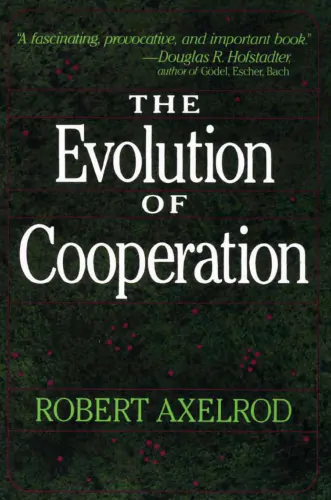
The Evolution of Cooperation (1984)

Portrait of Robert Axelrod

Robert Axelrod

Political Scientist
Born: May 27, 1943

Robert Axelrod is an American political scientist best known for transforming the study of cooperation through game theory. A professor at the University of Michigan, he gained international recognition for his pioneering research on the prisoner’s dilemma—a simple game that models trust and betrayal. By running computer tournaments in the 1980s, Axelrod showed that strategies rooted in reciprocity, like “tit for tat,” can outperform more cutthroat approaches, offering a powerful explanation for how cooperation can evolve even among selfish actors.

His work bridges political science, economics, biology, and psychology, earning him a reputation as one of the foremost thinkers on conflict and collaboration. Axelrod’s insights have been applied to fields as varied as international relations, cancer research, and the spread of norms in online communities. Awarded honors such as the National Academy of Sciences membership and the Johan Skytte Prize in Political Science, he remains a key figure in understanding how societies and systems find stability—or spiral into mistrust.

WIKIPEDIA ➦

1 Document

Filter

Sort

Alphabetic

Date

Duration

Word Count

Popularity

Mentioned in 1 document

Hans Moravec

Mind Children

Imagine attending a lecture at the turn of the twentieth century in which Orville Wright speculates about the future of transportation, or one in which Alexander Graham Bell envisages satellite communications and global data banks. Mind Children, written by an internationally renowned roboticist, offers a comparable experience: a mind-boggling glimpse of a world we may soon share with our artificial progeny. Filled with fresh ideas and insights, this book is one of the most engaging and controversial visions of the future ever written by a serious scholar.